
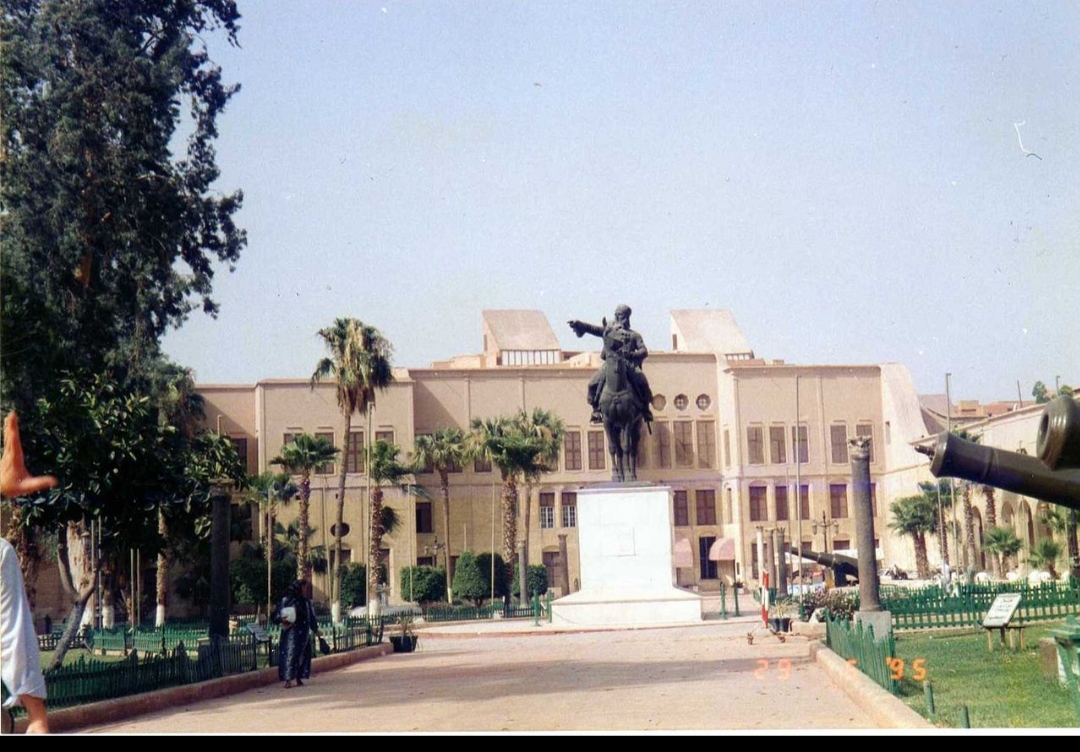
The Egyptian Military Museum
o


The Military Museum in Egypt was

 The Military Museum in Egypt was established in 1937 in the old Ministry of Defense building on Falaki Street in Cairo . Moved to a temporary building in Garden City in 1938, and it was moved and opened officially in Al-Haram Palace in the castle in November 1949 , it was refurbished and opened on 26/7/1982, it was developed jointly with the Antiquities Authority and opened on 4/26/1988, developed jointly with the Republic of Korea Democracy in 1990, and was inaugurated by former Egyptian President Mohamed Hosni Mubarak on 11/29/93.
The western sea rib of the castle is occupied by the so-called palaces of the Three Sanctuary, which overlooks Mount Mokattam, Al – Hataba and the door of the amphitheater (entrance to the castle). Muhammad Ali Pasha ordered the establishment of these palaces in 1812, beginning with the construction of the middle palace, then was followed by the eastern and western palace and was surrounded by one wall that was now demolished Which made the garden unfold in front of the central palace and these three palaces are almost similar in planning
The Military Museum contains a large number of halls that tell the honorable military history of the Egyptian army, starting from the Pharaonic era to the modern era, and the sections of the Military Museum are as follows:
Hall of Glory
It contains all the historical events of Egypt from the Pharaonic era until the Sixth of October War.
Military Fashion Suite
It includes the historical development of the military uniforms of the Egyptian army from the Pharaonic era to the Islamic era and the era of Muhammad Ali Bash until the modern era with a display of the clothes of the various military units. This wing also contains the flags that were used in Egypt throughout the ages in addition to the flags of the armed forces units currently, This is in addition to the ranks, decorations, and decorations of past and present, as well as the clothes of senior army commanders.
Artillery hall
It illustrates the historical development of artillery from its early inception and stages of development until the era of Muhammad Ali Pasha and the modern era, with examples of cannons being presented. Hall of Justice Council or the Summer Hall: It contains a model of Muhammad Ali Pasha during the ruling
Weapon hall
And presented the historical development of firearms until the modern era with a display of different models of these weapons in addition to a display of a group of siege weapons that were used over the walls of the castle.
The Pharaonic Wing
It includes historical and military events in ancient Egypt, with a display of some battles during the reign of both Thutmose III and Ramesses II in the diorama method accompanied by an audio recording in Arabic and English and ending in the Roman era.
Islamic wing
It contains the most important battles and war events from the beginning of Islam and a display of the battle of Mansoura at the end of the Ayyubid era and the battle of Ain Jalut in the Mamluk era with a presentation of the fortress models.
19th and 20th century hall
It includes several halls as follows:
The French Campaign Hall on Egypt includes all the events that went through this campaign, its battles and its results.
A gallery to display the beginning of the era of Muhammad Ali Pasha and the move that took place in Egypt to the ranks of modern countries, with a presentation of the rulers of the Muhammad Ali Pasha family and their history.
A hall containing the most important castles and forts in Cairo and the different coasts of Egypt, the main hall and contains paintings and statues of defense ministers during the reign of Muhammad Ali Pasha
Nazeeb battle hall, which includes a presentation of the battle of Nazeeb between the commander Ibrahim Pasha bin Muhammad Ali Pasha and the Turkish forces led by Hafiz Bey and the brilliant victory achieved by the Egyptian army in this battle
Hall of Khedive Said and Khedive Ismail and the most important military events of their era, then the Suez Canal drilling hall. This hall tells in detail the events of digging the canal and celebrating its opening.
A hall tells the events of the Arab revolution by Ahmed Pasha Orabi, with pictures of the leaders of the revolution and depicting Ahmed Orabi showing the demands of the army and the people to Khedive Tawfiq in front of Abdeen Palace.
Khedive Abbas Hilmi II Hall and Sultan Hussein Kamel and the most important war events that were in their era. The show also includes a showroom for striking the British of Alexandria and the British occupation of Egypt, then King Fouad Hall and King Farouk I, with depictions of some of the events of World War II.
Hall of the year 1952 AD and includes the events of the war of 1948 AD and the establishment of the July Revolution of 1952 AD and everything related to the events of the revolution with a stereoscopic presentation of the Revolutionary Command Council and the free officers who carried out the revolution, with a presentation of pictures of the presidents of Egypt as well as a display of pictures of defense ministers since the revolution, with a presentation of the 1956 war, in addition to To present the events of the Port Said epic and the tripartite aggression against Egypt.
Other halls
This is followed by two halls, one of which is related to the Yemen war and what is related to it, then a hall to display the war of 1967 AD, then the stage of attrition with a display of the most important battles in this stage, namely the Battle of Ras El-Ush and the destruction of the Israeli destroyer Eilat.
Hall of Victory and displays the achievements of the glorious October war in addition to a display of the weapons that participated in the war with a display of a model of the Special Operations Room for the October War, and includes the late President Anwar Sadat and Field Marshal Ahmed Ismail, Minister of Defense at that time, the team, the Shazly team, and Major General Mohamed Hosni Mubarak, the commander of the Air Force in At that time, Major General Mohamed Ali Fahmy, Commander of the Air Defense Forces, and Major General Fouad Abu Zekri, Commander of the Naval Forces. The hall also includes a display of weapons, which is specific to the Engineering Authority and military engineers, then the Air Force Hall, Air Defense Hall, Spectator Hall, and Sea Forces Hall The Paragliding Hall, the Armed Forces Supply and Supply Authority, the Signal and Thunderbolt Weapon Hall and the Border Guard.
As for the ground floor, it contains a wing for armored vehicles and the martyrs’ hall, where it offers the martyrs of Egypt from the war of 1948 to the war to liberate Kuwait.
The open exhibition hall contains a set of fighting equipment that were used from 1948 to 1973 in tanks and airplanes, and a display of some of the tanks that the Egyptian army seized from the Israeli army in the 1973 war.
See also
Salah al-Din al-Ayyoubi extraction
